
This article examines the Great Inequality in Saturn–Jupiter cycles through the lens of the Tychos model and the ancient doctrine of the Three Paths (Enlil, Enki, and Anu).
Table of Contents
Drawing on Hamlet’s Mill and traditional cosmology, it argues that the apparent acceleration and deceleration of Jupiter and Saturn is a perspectival phenomenon with clear astrological implications. It explores how this framework illuminates long-term Saturn–Jupiter triplicity cycles, mythic reversals of planetary rulership, and modern astrological considerations such as out-of-bounds planets and variations in retrograde motion.
The Great Inequality; Saturn-Jupiter Cycles
In Hamlet’s Mill: An Essay on Myth & the Frame of Time1, published in 1969, Giorgio de Santillana and Hertha von Dechend put forward the theory that axial precession was known and transmitted through mythology worldwide. They contend that myth contains key numbers, symbols, and storylines that convey how the cosmos works—explaining precession, or what is often called the Great Year: a period described as 25,900 years by Plato and currently understood to be 25,772 years.
Not only that, but myths across the world appear to contain similar stories conveying the same information. Here, we will examine Sumerian, Roman, and Greek examples. In the Roman pantheon, Enki was Saturn; in the Greek, Cronos. Enlil’s equivalent was Jupiter and Zeus. In these myths, a familiar story is told: Saturn/Cronos ruled a Golden Age. In an attempt to hold on to his rulership, Saturn/Cronos ate his children. But one was hidden and protected. At the appointed time, that son emerged, fought Saturn/Cronos, and won—casting him into the underworld, to the far corners of Hades or Tartary. The god who took over was Jupiter/Zeus, who began to rule the Iron or Dark Age. The Olympic Games were founded to honour this battle.
Though a similar story of rulership is not told in Sumeria (as far as we know), Enki and Enlil do represent opposing forces that were used to formulate an astrological/astronomical distinction known as the Three Paths2.
This story of conflict and rulership is particularly striking because, astrologically, we associate Jupiter with expansion, optimism, and beneficence as the greater benefic, and Saturn with restriction, darkness, and death as the greater malefic—nearly the inverse of what the myth itself conveys, and opposite to how Saturn/Enki and Enlil/Jupiter were understood in Sumeria. There, Enlil, irritated by the noise and disorder of humanity, called for their eradication through a flood, while Enki, by contrast, favoured humanity and sought to save them. So what happened?
Viewing the Great Inequality through the perspective of the Tychos may give us an answer.
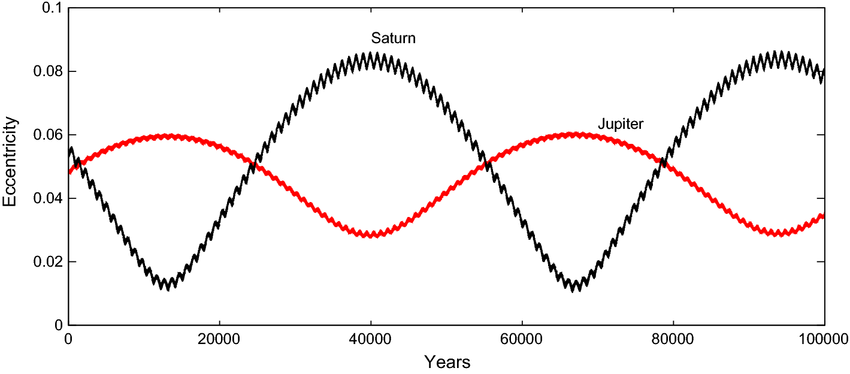
The Great Inequality was a historical crisis that threatened the foundations of astronomical science. In observing regular Saturn–Jupiter conjunctions, Jupiter appeared to be accelerating and was therefore hypothesized to eventually crash into the Sun, while Saturn appeared to be decelerating and drifting off into deep space. The stability of the entire solar system was called into question. Kepler was aware of the problem and hoped “future generations” would solve it. The greatest minds of the era—Halley, Flamsteed, Euler, Lagrange, Laplace, and Poincaré—struggled to find an answer. Special prizes were offered by the Paris and Berlin Academies. All attempts failed, and Newton, in particular, left it “up to God” to fix.3
Lagrange and Laplace eventually claimed the inequality was “temporary” and would reverse in approximately 900 years. When it did reverse, they were declared correct. However, the equations they used were as abstract as Keplerian equations and escaped the understanding of even the most capable minds. More recent attempts by Jonathan Tot, in collaboration with S. R. Valluri and P. C. Deshmukh, have produced even more formidable mathematics, building on the heliocentric model of Lagrange and Laplace. Yet these, too, do not truly provide an answer; instead, “beginning the exploration rather than completing it.”
The convoluted solution preserved the conclusion that the pattern reverses while allowing our thinking to remain focused on Copernicus, Kepler, and Newton. Yet a far simpler answer exists when viewed through the framework of the Tychos—the updated Tycho Brahe model of the solar system.
Astrology often exhibits a lack of confidence and attempts to justify itself through appeals to science and astronomy. Even for those who fall into this category and are not inclined to accept the Tychos system as an accurate model of the solar system, an understanding of it remains valuable. The Tychonic system prevailed throughout the Middle Ages until the time of Newton and provided the intellectual context in which much of astrology re-emerged. It may be argued that a model similar to the Tychos system was known at a much earlier period and later lost. Within such a framework, the theory advanced by Giorgio de Santillana and Hertha von Dechend—that knowledge of precession may extend back to Neolithic humanity—begins to appear plausible.
Using the Tychos model, it becomes clear that the Great Inequality is the result of an optical illusion caused by Earth’s slow motion around its PVP orbit. In the Tychos, epicycles are real, known astrologically as retrograde loops. Planets genuinely move backward over certain degrees as they circle Earth from Earth’s perspective. The Tychos does not require Keplerian speeding up and slowing down of planets to match the ephemerides; instead, it requires Mars and the Sun to orbit in overlapping paths, while Mercury and Venus circle the Sun as the Sun circles Earth. Retrograde loops keep everything aligned. This was essentially Tycho Brahe’s model. The Tychos adds Earth’s 25,344-year orbit, known as the PVP (Polaris–Vega–Polaris) orbit.4
Jupiter and Saturn lie on the outermost reaches of the traditional solar system, making them the two farthest visible planets from Earth. They conjunct every 60 years—Jupiter completing five 12-year orbits and Saturn two 30-year orbits in the same span. When these conjunctions occur in the upper quadrant, Jupiter appears to accelerate, as though Earth itself were moving in the opposite direction. When the conjunctions occur in the lower quadrant, Saturn appears to accelerate, as though Earth were moving in the same direction.
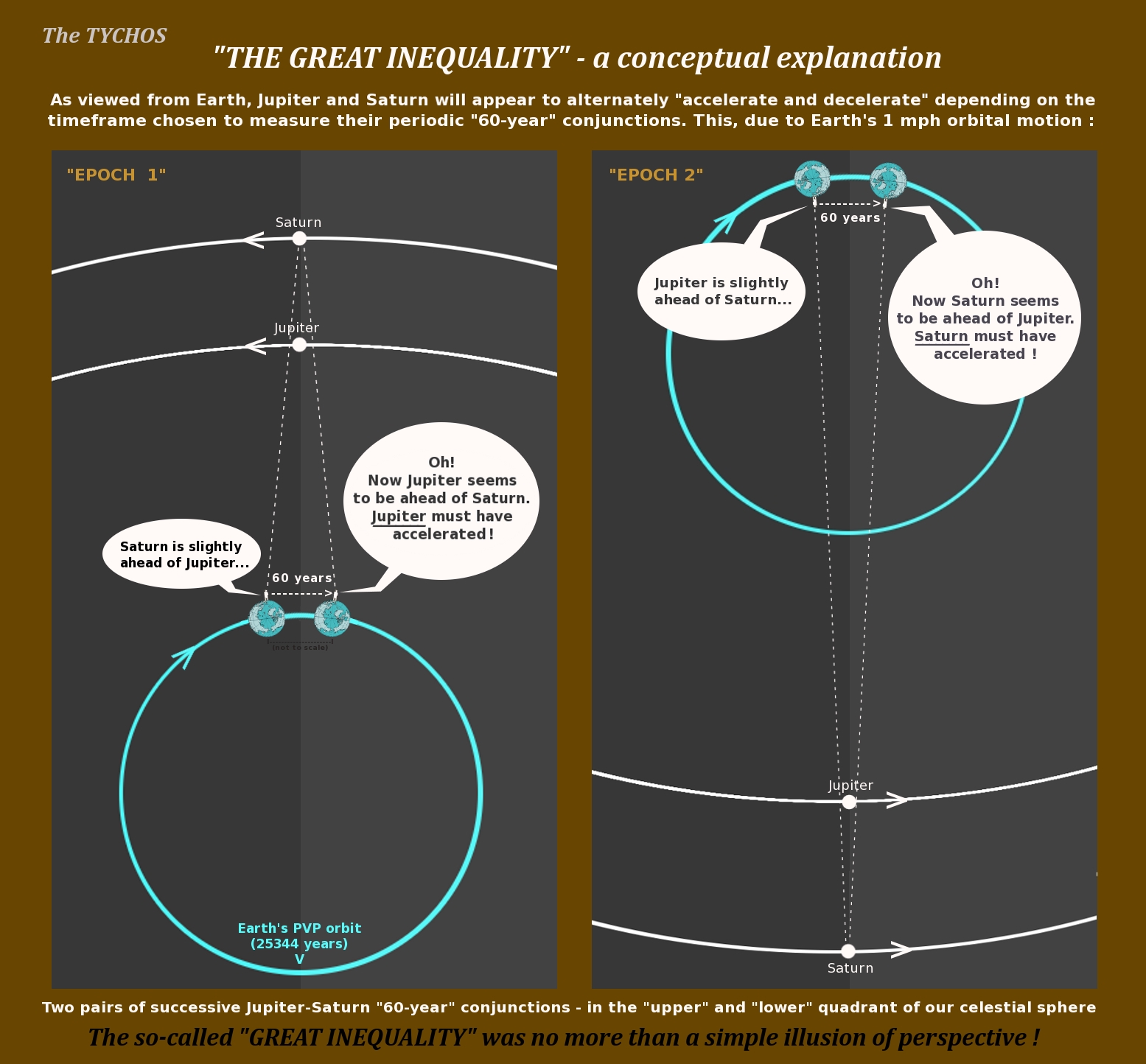
In reality, both planets move at perfectly constant speeds. The apparent acceleration and deceleration are purely perspectival effects. Simple geometry demonstrates how overlapping orbits, epicycles, relative size, and speed create the illusion of changing velocity as planets circle within larger systems.
The Three Paths
The Great Inequality tells us that when Saturn–Jupiter conjunctions are weighted in the upper quadrant, Jupiter appears faster; when weighted in the lower quadrant, Saturn appears faster. The ancient astrological distinction known as the Three Paths —poorly understood today—may help explain this.
The Three Paths is an astrological distinction in Sumerian and Babylonian astrology in which Enki rules the southern hemisphere and all stars therein. Enlil rules the northern stars, and Anu the equatorial band with stars that show up in both hemispheres (Virgo–Pisces is southern; Aries–Virgo is northern; our zodiac often confuses north from south, where we expect north to be “up”).
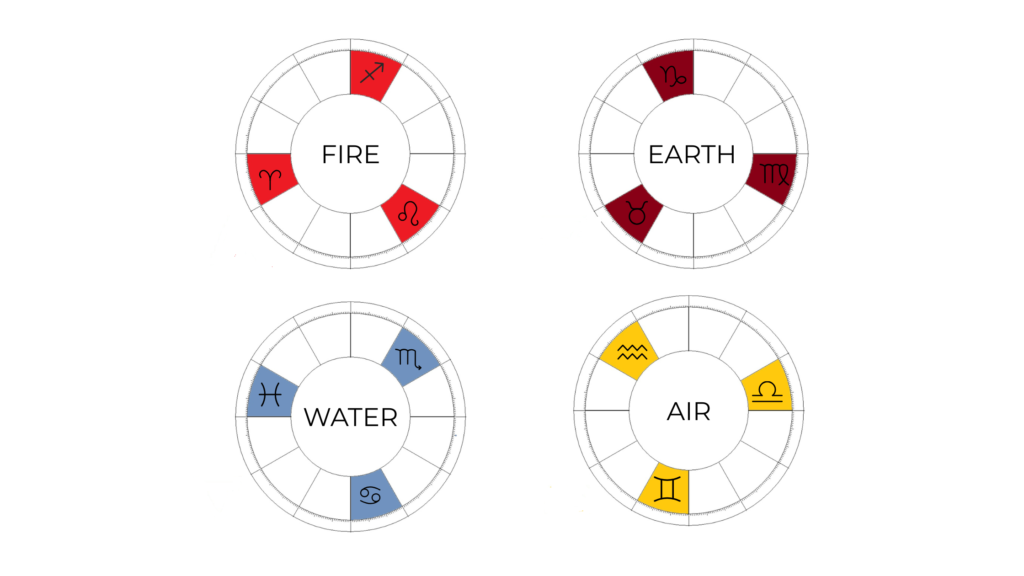
When earth and fire triplicities dominate, the Saturn–Jupiter conjunctions are weighted in the northern hemisphere, making Jupiter/Enlil “king.” When water and air triplicities dominate, the southern hemisphere prevails, making Saturn/Enki “king.”
The PVP (Polaris–Vega–Polaris) Orbit
Saturn is the time lord, and Saturn–Jupiter conjunctions clearly relate to time. A conjunction in the same sign occurs every 60 years—60 being foundational to timekeeping. While the mechanics of triplicity and precession are beyond this article’s scope, the triplicity moves backward through the zodiac in approximately 2,383 years. The authors of Hamlet’s Mill found this tolerably close to a double hour in the Great Year. It is even closer to the PVP orbit, with 32 trigons completed in 25,418 years—just a 73.6-year difference; a metaphorical Pythagorean comma.
“To move through the whole zodiac, one of the angles of the Trigon needs approximately 3 × 794⅓ = 2383 years.” — Hamlet’s Mill
Saturn and Jupiter conjunct every 20 years. For approximately 200 years, these conjunctions occur within one triplicity. Each element contains three signs, and Saturn–Jupiter conjunctions remain in one element for about 200 years before moving to the next. We have recently moved into air-sign conjunctions; the previous 200 years occurred in earth signs. Within each element, one sign lies in one hemisphere while the other two lie in the opposite hemisphere, as mentioned above. As a result, during a 200-year Saturn–Jupiter triplicity cycle, one side of the zodiac dominates the other. But over the Great Year, this perspective changes.
Earth’s orbit in the Tychos is considerably slower, taking 25,344 years to complete. Earth is currently in the northern part of its orbit, with north pointed at Polaris in Gemini (this points our equinox to Pisces). Over the Great Year, Earth will move into the southern quadrant of its orbit, changing perspective once again. Thus, for roughly half this cycle—about 12,000 years—the apparent speed dominance of Jupiter and Saturn reverses again.
Here we return to myth: Saturn rules the Golden Age; when Earth travels through the southern Enki sector, Saturn is king. Jupiter rules the descending Iron Age; when Earth travels through the northern Enlil sector, Jupiter is king. Jupiter as harsh and Saturn as kind takes us somewhere very different astrologically. Do planetary expressions switch during the Great Year? Does Jupiter become the greater malefic and Saturn the greater benefic? Do the underworld expressions of the planets dominate when Earth is in Enlil/Jupiter territory, and the reverse when moving into a Golden Age? Mythology suggests that they do. Even Ceres—whose myth is indirectly about the Sun—has her seasons.
And what of Anu, the god of the horizon? This path seems to be ignored in the tale until we realize that there were, in fact, three generations of gods in the Sumerian pantheon and a similar three in Rome. Before Cronos was Uranus, whom Cronos took the throne.
Uranus and Anu were both primordial sky gods, ruling in a time of chaos and upheaval. And here we encounter another riddle: Libra lies on the western horizon, archetypally balancing light and dark.
Another poorly understood ancient concept may help us here: Nibiru. In Sumerian and Babylonian texts, both Mercury and Jupiter are called Nibiru. No other planets are clearly assigned this title, though many tablets remain untranslated. Nibiru means “crossing” or “point of transition” and appears in the Enûma Eliš and MUL.APIN. Texts associate it primarily with Jupiter near the autumnal equinox, and with Mercury when it “divides the sky and stands still.”
Tablets K.6174:9’ and K.12769:6’ state: “If Mercury divides the sky and stands there, [its name] is Nibiru,” linking it to Mercury (MUL UDU.IDIM.GU4) when bisecting the sky.
Mercury does stand still during retrograde, particularly when crossing the ecliptic band. This suggests Nibiru is a condition, not a planet (as fans of Zecharia Sitchin believe). Earth itself may become Nibiru twice during the Great Year—a concept echoed in Plato’s work describing treacherous orbital zones linked to cyclical disasters.
Planets Out of Bounds – Rosie Finn’s Work
Recent astrological works may lend modern interpretation to the Three Paths. Planets travelling within the ecliptic behave normally, but when they go out of bounds—north or south of the Sun’s 23.27° band—they behave differently.
In Persephone’s Revolution: Pluto’s Path to the End of Empire5, Rosie Finn demonstrates that when Pluto is out of bounds in northern declination, power becomes centralized and authoritarian—closely describing the path of Enlil. When Pluto is out of bounds in southern declination, power shifts to the people; revolutions and human rights movements emerge. Here, the path of Enki is well described.
Planets Retrograde – Gary Caton’s Work
Planets travelling within the ecliptic band behave normally—unless they are retrograde. Gary P. Caton6 has shown that not all retrograde loops are astrologically equivalent. His work aligns naturally with the Three Paths when viewed geocentrically. Retrograde motion differs by hemisphere and latitude. Gary aligns these varied loops to different phases of the year, which also fits neatly with the Great Year. Spring and fall align with the ecliptic band (Anu), with snake-like retrograde motions reflecting Anu and the condition of being Nibiru. Winter aligns with Enki, and summer with Enlil.
Conclusion
Astrologically, the Great Inequality cannot be fully understood within the Copernican framework. The heliocentric model, with its wobbling precession and illusory retrogrades, obscures the lived perspective. The Ptolemaic system gets us closer but fails to explain precession. Astrologers work geocentrically yet mentally defer to heliocentrism, discarding what they actually see.
Hamlet’s Mill takes us back at least to Neolithic times, allowing the medieval Tychos framework to extend further into the past. Within this model, the Three Paths of Enlil, Enki, and Anu finally make sense—across the Great Year, out-of-bounds planets, and retrograde loops shaped by latitude.
The implication is profound: Saturn, Jupiter, and perhaps all planets—including Earth—operate differently in the northern and southern hemispheres. Rosie Finn’s work on Pluto aligns powerfully with this ancient distinction. Retrograde loops allow us to include Anu. And while certainty is impossible, the implication remains: a time will come when Jupiter is overthrown once more, signalling the return of a Golden Age.
So we can say:
- Enki (Saturn) rules the southern hemisphere, lower quadrant, and planets out of bounds in southern declination. Planets express positively here, and when Earth is in this sector during her Great Year orbit, she experiences a Golden Age ruled by Saturn/Enki.
- Enlil (Jupiter) rules the northern hemisphere, upper quadrant, and planets out of bounds in northern declination. Planets express powerfully here, while Earth in this quadrant experiences a Dark Age ruled by Jupiter/Enlil.
- Anu (Uranus) rules the ecliptic. Direct planets operate normally here, but when retrograde, they experience transition and transformation. Earth transiting here may also experience transition and transformation.
de Santillana, G., & von Dechend, H. (1969). Hamlet’s mill: An essay on myth and the frame of time. Gambit.
https://en.wikipedia.org/wiki/MUL.APIN
Shack, S. (2023). The Tychos: Our geoaxial binary system (2nd ed.,), chap. 17: “The Great Inequality” – solved by the TYCHOS.
Shack, S. (2023). The Tychos: Our geoaxial binary system (2nd ed.), chap. 4, “Introducing the TYCHOS model.”
Finn, R. (2024). Persephone’s revolution: Pluto’s path to the end of empire. Revelore Press.
Caton, G. P. (2017). Toward a multi-dimensional view of retrograde motion. Geocosmic Journal, Winter 2017, 15–18. National Council for Geocosmic Research (NCGR).