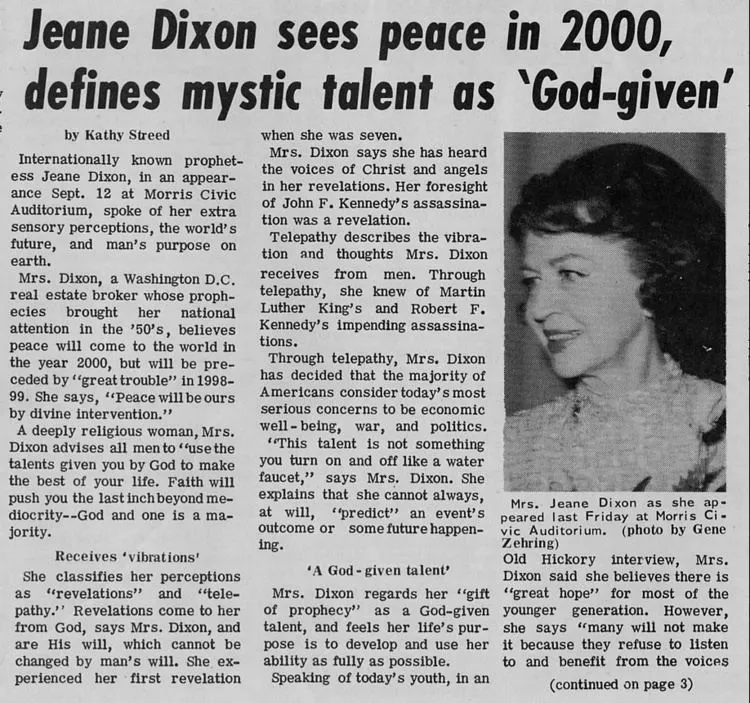
Jeane Dixon predicted that a child born shortly before 7:00 a.m. EST on February 5, 1962, in the Middle East would rise from humble origins—possibly descended from ancient Egyptian royalty—to become a unifying, Christ-like spiritual figure who would influence global society and bring humanity together in a single faith by the end of the 20th century. She believed this individual’s influence would grow during the 1980s and be fully realized by the 1990s, promoting peace and social transformation. Dixon (1918–1997) was a well-known seer who also gained public attention for predicting events such as the assassinations of Mahatma Gandhi, Martin Luther King Jr., John F. Kennedy, and Robert Kennedy, as well as the launch of Sputnik and the sinkings of the USS Thresher and Scorpion.
Some later interpretations suggested that Dixon’s prediction could be read as foretelling the Antichrist, largely because it described a figure associated with a one-world religion. This interpretation reflects concerns often linked to Aquarian themes of global unity and peace. Notably, February 5, 1962, coincided with a solar eclipse in Aquarius, with Mercury, Venus, Mars, Jupiter, and Saturn also positioned in Aquarius. Such an astrological configuration has been associated by astrologers with collective movements, technological themes, and large-scale social change. The same date is also the birthdate of Simon Shack, author of The TYCHOS – Our Geoaxial Binary System, who was born in Sweden.
Clan Mother Worldwide’s Sacred Sky Substack is a reader-supported publication. To receive new posts and support my work, consider becoming a free or paid subscriber.
From an astrological perspective, Aquarius is often associated not only with technology—such as computing and astronomy—but also with symbolic or spiritual concepts. The image of the water-bearer has historically been interpreted as representing the transmission of spiritual knowledge. In this context, Aquarius is viewed by some as complementary to religious traditions rather than in opposition to them. A frequently cited biblical passage states, “When you enter the city, a man carrying a jug of water will meet you. Follow him to the house he enters,” which astrotheological interpretations have associated with the sign of Aquarius.
Simon Shack turned 64 today, having been born on February 5, 1962. His birthdate has been publicly shared on the TYCHOS Forum. Shack is known for revisiting foundational assumptions in celestial mechanics and for proposing alternative interpretations of the motions of the Sun, Moon, and planets, which, if largely accepted, would change everything!
My professional interests differ somewhat from Shack’s. I tend to focus on planetary symbolism, cycles, and their perceived effects on human experience. In a recent exchange, he shared the right ascension positions of the planets for his birth date in 1962 and for the present day. Although Shack prioritizes scientific methodology and generally avoids astrological discussion, he acknowledged the significance of the date by referring to it as “a special birthday.” To me, this feels like a crack open into the meaning and the spirit of the planets.
Discovering and engaging with Shack’s work has led me to a profound understanding of planetary cycles and their historical interpretations, and for that I am deeply grateful to him. It has also led me to consider the possibility that Simon’s discovery may in fact be a rediscovery of much older frameworks, some of which are thought to have had spiritual or religious significance, including possible connections to early Christianity. To me, this brings a deep significance to Shack’s work, because it leads us back to the possibility of the reintegration of science and spirit… So with that, here are five hints that the Tychos model may have been known:
The Antikithera Device (our oldest known computer)
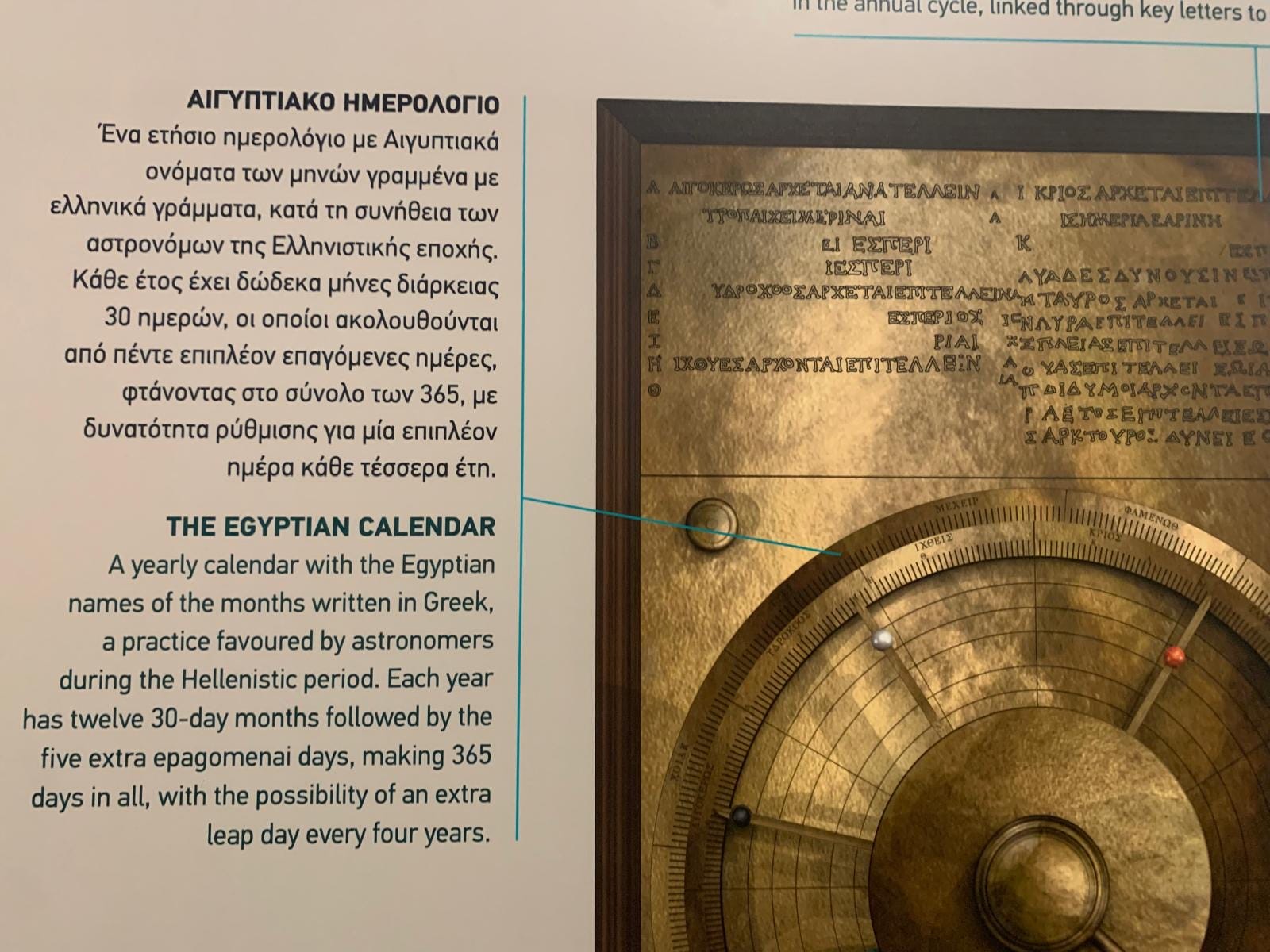
In 1901, sponge divers found a shipwreck off the coast of Antikithera in the Greek islands. In and among the many amazing treasures was a device, caked with shells, but worth something; it has a tarnished green look, indicating copper. Over the last 120-plus years, researchers have pieced together just what this device was. It was discovered through high-tech scans that the device predicted the movement of the planets and stars. On the back, it had two moon dials. One shows the Metonic calendar, a 19-year solar-lunar calendar. The second one tracked the saros cycle of the moon – It was an eclipse predictor. On the front was a zodiacal dial with an outer dial depicting a moon calendar. The hands on the dial were the Sun, Moon and 5 planets. Amazingly, the scientists and researchers were able to see the gears, including the teeth that were used to generate the analogue computer. And they fit them together, making it work. And even though it worked, they had one gear left! A 63-toothed gear. For over a hundred years, it was studied, but recent technological advances have allowed further scans of the device, allowing researchers to know exactly how the mechanism worked. In the most recent re-creation, they were able to put together all of the gears to create a device that measured the moon calendar, solar calendar, lunar/ solar calendar, solar eclipses, and the movement of all planets, including retrogrades. They were able to tell when the device began calculating based on lunar information and what was written on the device, and knew that the device was 2000 years old. They were able to do this with exact accuracy.
The device, as is, is one month out of alignment. The exact number of days it would be out of alignment if precession were not taken into account. Interestingly, the Mayans had a gear in their calendar system that had also had 63 spokes. Across the Atlantic Ocean in the Maya Peninsula, records of the Mayan calendar were found. While the records date to about the same time as Hipparchus in the western world, it is said that the knowledge goes back at least 5000 years. The Mayan calendar turns with interlocking cycles and counts. It was discovered in 2016 that the Mayans also had an interlocking cycle like a gear with 63 teeth. This ‘gear’ was said to play a part in a larger cycle of Venus and Saturn.
Venus and Saturn likely play a part in predicting precession (I go into this further in my upcoming book Binary Star Astrology). The implication is huge! Researchers have been able to fit together a device depicting our solar system, but, like putting together Ikea furniture without the instructions, they still have one piece left. And it seems that the one feature missing from the Antikethera mechanism is precession… It seems likely that the missing pieces would correct the 30-day error due to precession… and this would imply that our solar system, including precession, was already figured out 2000 years ago.
The Egyptian hieroglyphic spelling of the god of Earth
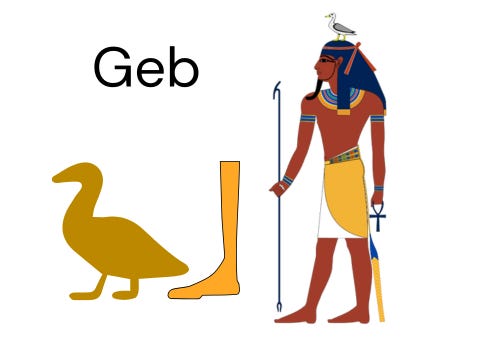
In Ancient Egypt, the god Geb was the god of the earth. He is often seen lying under Nut, the sky goddess. The hieroglyphs, particularly in the Old Kingdom, for the Geb are a leg and a goose. The Egyptians used hieroglyphic symbols to depict important qualities about each of the things they were naming and describing, and they also provided a phonetic sound. The goose lives near water, mud and marsh, and this perfectly describes the fertile earth of the Nile region. The leg in front of the goose brings to mind a goose walking on land. How quickly does a goose walk? Slowly, waddling along at a pace of 1.6km.
Simon Shack uses the image of a snail on the cover of his book to depict the slow pace of the Earth’s motion. His main addition to the Tyhonic model of Tycho Brahe was this orbit of Earth; Earth moving at 1.6km (1 mile per hour) over 25,344 years to complete a Great Tychos Year.
Did the Ancient Egyptians know the orbit of the Earth? We know they were great mathematician who could measure the circumference of the Earth, so it’s not hard to imagine that they did. And it seems likely that the hieroglyphs were telling us something about the pace at which earth moved, implying again that the ancient world knew the celestial mechanics of our solar system perfectly.
The Egyptian identification of gods as Moons
The Moon, Venus, Mercury, Phobos and Deimos all only show one side of their face to us. This is the definition of moon, and so by definition, Venus, Mercury and the Moon are all moons. The moon is Earth’s moon; Venus and Mercury are the Sun’s moons. Mars also has two moons, Phobos and Deimos.
We are all very familiar with the moon’s lunar cycles. We see them in the sky every month. But what is not always recognized is that Venus and Mercury also display phases; this is true whether you are looking at these planets through the Copernican model or the Tychos model. In 1610, Galileo Galilei discovered these phases through his newly invented telescope. Yet, curiously, these phases may have been known by the Egyptians, and this may have been the reason that they had more than one lunar god/goddess!
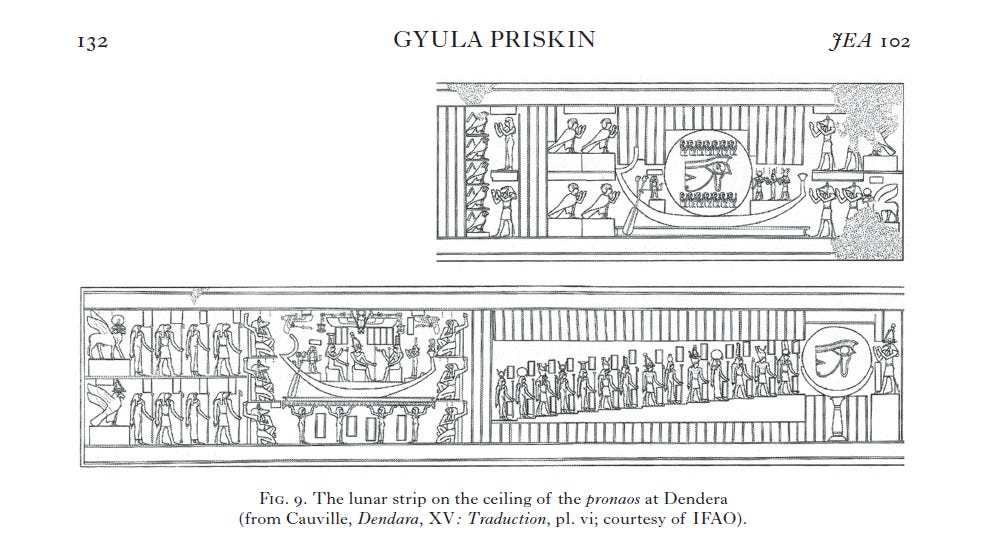
In Dendera, in the hypostyle hall, between the zodiac are several other rows with depictions of various other cycles. One complete row is said to display the moon cycle with Osiris. Scholars have explained Osiris as the moon (Osiris-Iah), and their explanation is that Osiris becomes the moon within these depictions. But they limit their understanding of the moon to the only moon that we know of in our modern day. The main moon gods and goddesses in ancient Egyptian mythology are thought to be:
- Iah (Yah, Aah) – The Moon
- Khonsu – A later version of the Moon
- Thoth: A god of wisdom, writing, and magic. He is Mercury
Though not completely attested, there are goddesses that are lunar in nature. They are depicted by their lunar headdress and associated with the moon in ancient texts. They are:
- Seshat, consort of Thoth. She is often seen with a seven-pointed star and a lunar crescent above her head.
- Auset/Isis, who is associated with the full or waxing Moon. Isis is often seen with a lunar crescent above her head.
- Nephthys, not explicitly a moon goddess, is associated with the waning or dark moon. Nephthys is dark and more occult.
If we shift our thinking to include Venus and Mercury as lunar, then the lunar journey of Osiris on the Dendera ceiling, along with why gods and goddesses connected to Venus and Mercury are lunar in character, starts to make more sense. I go into this more deeply in my book, but as a very high-level overview:
- The first panel – The Sun and Mars cycle – a 32-year cycle with approx 14 conjunctions of Mars with the Sun…. This links Osiris to Mars, and 14 is clearly shown in this depiction. Academics have connected it to half a cycle of the moon phase. But the moon’s sidereal phase is 27 days, and its synodic phase is 29.53. The Egyptians rounded up to 30 days. 14 does not fit into that cycle.
- The second panel – The Venus, Sun and Mars cycle – Mars making 5 conjunctions with Venus in the 32-year cycle – shown as 5 Horus birds.
- The third panel – The Mars, Sun and Mercury cycle – each of these bodies has a 79-year cycle – there are 79 columns surrounding this panel with 14 gods ascending to the wadjet eye and Thoth, who is a moon god.
The Ancient Egyptians had remarkable technology, and it’s not too far-fetched to conceive that they may have been able to see these phases.
The five days out of time
Several ancient cultures had a calendar of 360 days. In Ancient Egypt, the Egyptian Civil Calendar was tied to the Sothic Calendar of 360 days, but in 2773 BC, the Civil Calendar was standardized to 365 days. Five epagomenal days were added, dedicated to Osiris, Isis, Nephthys, Seth and Horus. The establishment of the calendar was not associated with a Pharaoh making a declaration in order to fix the year, but rather by a myth.
The Earth moves around its long 25,344-year PVP orbit in one direction, and the Sun moves in the other. Earth has two motions: while Earth is moving in its direction around its orbit, it is also rotating counterclockwise about its axis, moving west. The Earth spins around its own axis 366.256363 times in one year and moves along its orbit at a speed of 1.6 km/h. On the other hand, the Sun also has two motions. It is moving in the opposite direction, also rotating counterclockwise and moving east. As the Sun moves in its direction, it does so by 1 degree per day as measured against the stars. There are 360 degrees in a circle, so it seems it should take 360 days to complete one year and return to meet up with the same star as viewed from Earth. But a solar day is 4 minutes longer than the sidereal day. The solar day is 1440 minutes, and a sidereal day is 1436 minutes. Taking into account all of these motions – Earth’s spin counterclockwise and its movement west, and the Sun spins counterclockwise, and a 1-degree motion east – 5.2 extra days are created. These 5.2 describe the relationship between the Earth’s two motions and the Sun’s motions.
There is no other reason for signalling out these 5 extra days, unless of course,e they understood the celestial mechanics of our solar system in the same way as in the Tychos.
The Thema Mundi
The Thema Mundi1, ‘world theme’, is not well understood. In fact, it’s confusing. The world theme was developed by the Hellenists and appeared about 2000 years ago, depicting the order of the planets. This order doesn’t make sense in the Copernican framework, and attempts to understand it lead interpreters to conclude that the ancients were confused.
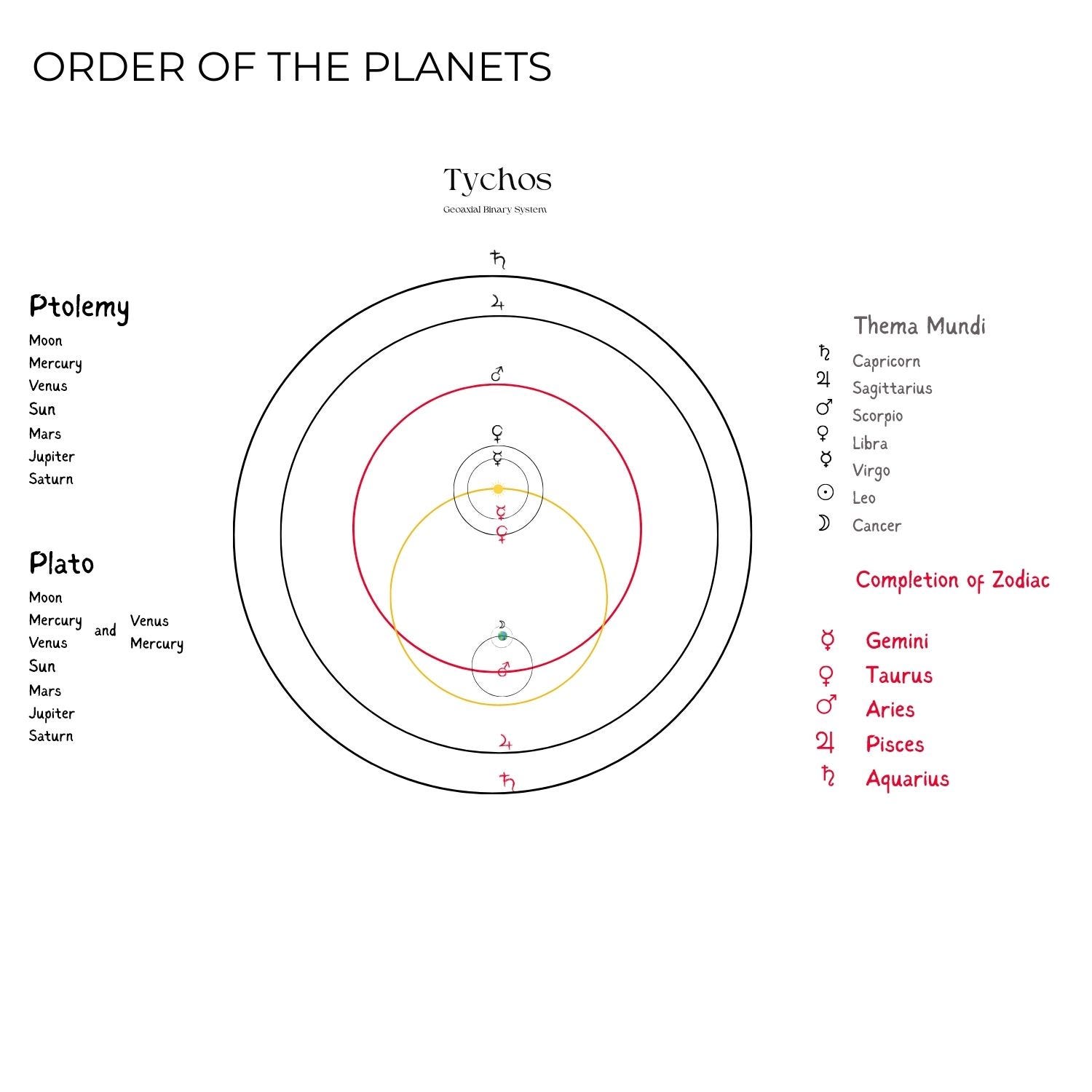
The Thema Mundi places the order of the planets starting from the sign of Cancer, Leo, Virgo, Libra, Scorpio, and Capricorn. The corresponding planetary path is the Moon, the Sun, Mercury, Venus, Mars, Jupiter and Saturn.
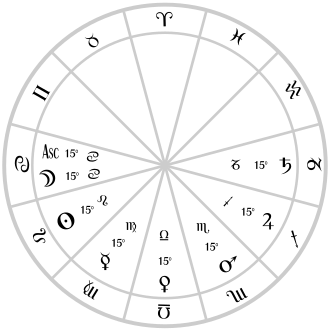
Yet when we map the Thema Mundi on the Tychos model, the planetary order shows the spheres going up through the model in this very order. Its path is Moon, then Sun, followed by Mercury at Superior conjunction, Venus at Superior Conjunction, Mars conjunct the Sun, Jupiter and Saturn in their longest elongation.
Going to the bottom of the model takes us to the other side of Saturn’s orbit, which then starts the rest of the order from Aquarius back up to the Sun (these are marked in red). This fit’s so well that it seems hard to imagine that the Thema Mundi was not developed without knowledge of this model – Thema Mundi doesn’t make sense in any other way.