
The Gregorian calendar has been blamed for throwing us off.
The Gregorian calendar was introduced in 1582 by Pope Gregory the 13th. It was created to correct the Julian calendar and to align it with the Council of Nicaea, particularly with respect to Easter. 11 days were deleted from the calendar… poof! Just gone.
But there are other “adjustments” made to time and calendars that have seemed to throw us off kilter: The months are disoriented. For example, the word for September means seven in Latin, but it’s the ninth month. The word for October means eight, but it’s the tenth month. Daylight Saving Time shifts the time back and forth in the spring and fall. CERN is a more recent disorientation. If you want to go down the rabbit hole of time, CERN has also been blamed for shifting timelines, creating the Mandela effect – the phenomenon where large groups of people remember different histories. In the case of Nelson Mandela, one history is that he died in the 80s in prison. Another parallel history is that he was released from prison and became President, dying much later…
So let’s see if we can untangle the disorientation and reorient ourselves to what time and the calendar are.
Time is not broken. But our perception of time is.
Let’s start with the Julian calendar. The Julian calendar was created by Julius Caesar, and he wanted to create a more accurate calendar than the 304-day Roman Calendar. Julius Caesar created a 365.25-day calendar, rounding up the actual time that the sun takes to return to the same star. Over time, the rounding up resulted in inaccuracies and the calendar shifting that were true errors. The Gregorian calendar was an attempt to correct this by the Catholic Church. The Catholic Church was very concerned about when Easter happened – Easter happens using a lunar-solar calendar. Easter is the first full moon after March 21st – the vernal equinox. To realign the date, the Gregorian calendar used a much more accurate calculation of the year so that, over time, the calendar dates would not shift.
England was not happy with a calendar that was created by the Catholic Church, and so Queen Elizabeth commissioned John Dee to create a calendar for the British. John Dee’s calendar used a 33-year cycle. A year is a leap year if, when divided by 33, the remainder is a non-zero multiple of 4. This resulted in a more uniform distribution of leap years, only four or five-year intervals, unlike the Gregorian calendar, which occasionally has an 8-year gap1. Though it was far more accurate than the Gregorian calendar, closer to the actual time the sun takes, it was never adopted.
Interestingly, John Dee created his calendar using a meridian that started from Washington, DC. It became known as God’s Latitude (it also runs through Cuba, Jamaica and Peru) and is the 77th meridian from the current Greenwich meridian. In fact, in Washington, there is a park called Meridian Park. And it seems clear that the medievalist/John Dee’s calendar and later Masonic ideas found a place, as the 77th parallel is the corner of the Capitol Building in Washington.
There were several reasons he used this meridian. It was the place where light and dark occurred equally at exactly the vernal equinox for over 300 years, and it was in a location that medievalists considered the New Jerusalem. But the location where the light is equal during the equinox shifts as we move through our solar system. It continues to move eastward.
Thus God’s Longitude now exists at this band of longitudes around 74°30’ W. Consulting a map of the world we find that New York City (73°58’), Bogota (74°5’) and Guantanamo Bay (75°14’) are all within this band. – Peter Meyer
And this is the point. We are continually moving. Trying to pin down time to a frozen linear spot only works for a period of time, no matter which calendar you use.
When Julius Caesar created the Julian calendar, he ignored the math and geometry of the earth and rounded up the time it took for the Sun to circle the earth and return to the same star. As mentioned, the Julian calendar created a 365.25-day year – even. The fact that the Romans had a 304-year calendar seems to point to the truth that the Romans knew very little about the solar system and the seasons, and instead focused on the moon. In trying to fix it, the seventh month was now the ninth month, the eighth month was now the tenth month – Think of what it must have been like to say seven, but really mean nine in those days… disorienting.
The people who knew about the true movement of the Solar System were the Egyptians, the Sumerians and the Greeks.
The Lunar/solar calendar by the Sumerians is very accurate. Called the metonic calendar, it aligns the sun and moon every 19 years. It is what is used to help predict eclipses. And we can predict them very accurately, combined with the saros cycle. The moon shifts through the solar year until it comes back to the same place 19 years later.
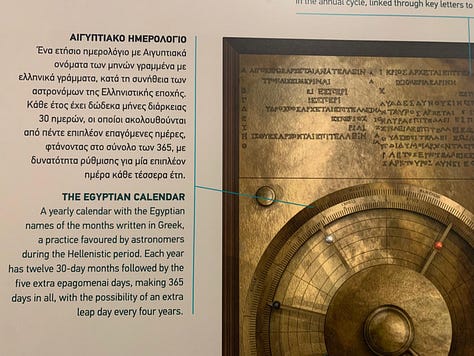
In Egypt, a sothic calendar was used, which also rotated. During that time, Sirius would rise and start the calendar one day later every four years. Sirius (Sothis) returned to begin again on the same day of the calendar every 1460 years. The Greeks wanted to keep the year steady in time, and five epagomenal days were added and fixed. This post explains those five epagomental days. They existed in the Egyptian and Mayan calendars and have a mathematical and geometric reason, as outlined in the Tychos. This type of calendar is still used in Ethiopia but sadly, pressure is being put to no longer use the 13-month calendar (12 – 30-day months and an additional month with 5 days or 6 during a leap year). Understanding how the solar system moves is essential to understanding time!
In Greece, the Antikythera mechanism was found. It was created before the Julian calendar and had the Metonic calendar and the Egyptian calendar of 360 days plus 5 days and adjustments for leap years! So we know that the movement of the Earth was known before the Romans came and really messed it up!
The Gregorian calendar fixes the Julian calendar by correcting the math; it deleted 11 days, which needed to happen if the math was going to be corrected. But over time, it will also shift because it’s a calendar that attempts to fix days in one spot. The tropical vernal equinox will one day point to Aquarius and then Capricorn, etc, over thousands of years.
That our clocks and calendars have been distorted is our perception. Time has always been time. We have simply been looking at a clock and a calendar that we want to remain fixed in time, and in fact, they always move. A solar year is 365.2425. Everything in our solar system moves; the Sun, Earth and even the stars. In other words, nothing in our universe is broken or distorted; it’s just that we have been looking at a broken, fixed clock and calendar.
As for timelines…. time only happens here on earth. It’s an earth measurement. As we move out into space, time does not exist. So history and timelines are distortions of the material world. The fact that we cannot fix them in one spot points to their divinity!
From the Tychosium… the movement of our solar system.
Time is non-linear.